





August 21/09 21:23 pm - Specialized Global Product Launch 2010 - Men's Mountain Bike
Posted by Editoress on 08/21/09
Specialized Bicycles invited Canadian Cyclist to the debut of their 2010 bicycles in Snowbird, Utah. Our Tech Editor Mike Badyk attended, and his report has been broken into three parts - Road, Mountain and Women's Series. This report covers the 2010 Specialized Men's Mountain Bike line.
Photo gallery
The folks from Specialized began the launch with the media being the first guests, followed by presentations to their U.S. dealers (Specialized Canada did a similar launch in mid-August). With the journalists on site, the focus was the higher end product. There were presentations from engineers and designers and, of course, the opportunity to ride some of the bikes. Before arrival you had to decide if you were going to focus on mountain or road bikes. There was so much to see that it was virtually impossible to do both. My primary focus was the mountain, but I did have a chance to do one brief road ride and also had a glimpse at some of the new road bikes, as reported separately.
Snowbird is a very beautiful ski resort on the outskirts of Salt Lake City. SLC is flat, but head south from the city centre and turn east up a canyon and you quickly enter some serious mountains. After climbing a winding road we were presented with a gorgeous facility nestled in a narrow valley, with massive snow capped peaks towering above. You immediately notice the altitude. At over 8000 feet above sea level, it was a chore to even get the luggage out of the van. Acclimation was the order of the whole event. There wasn't a lot of flat ground here either. You were either going up or down, no matter which way you headed. The nice thing is that Snowbird, which is very, very busy in the winter, is much quieter in the summer. The roads are lightly traveled, there are lots of mountain bike trails, and there were lots of meeting rooms available for the presentations. The inside joke was that it was selected for its sheer absence of golfers. Specialized set up one tent up above the resort for the demo road bikes and another below for the mountain bikes. Check out the photos to get an idea of the beauty of the location. Talk about a kid in the candy store. Make a request for the bike you wanted to ride and the Specialized techies would set it up for you and away you went for a ride. Then go back and repeat as desired. Way fun.
The lead off to this presentation was 29ers. Let's just say that Specialized was trying very hard to push this design. It began with a slight admission that they were a bit behind the other manufacturers in terms of 29 inch wheel bikes. The second push was practically begging the European journalists on hand to promote 29ers to their readers. It seems like 29ers are now big business in the U.S., a bit smaller in Canada, and virtually non-existent in Europe. There was a bit of musing between the Specialized folks and the European based journalists, but I don't think a clear consensus was ever reached as to why this is the case. However, we'll move ahead. I own, and thus like, both wheel diameters. I don't think one is overtly superior to the other, as they have respective strengths and weaknesses depending upon the rider and the terrain.
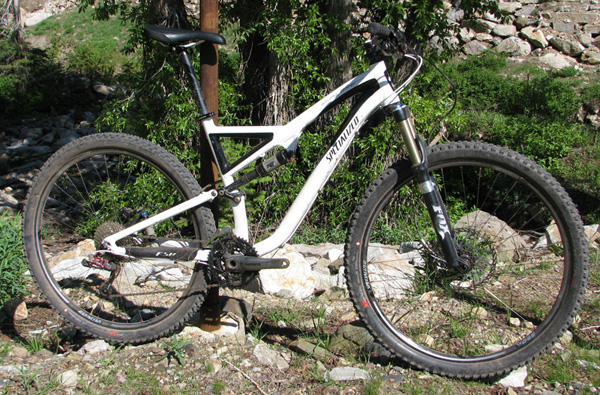
You might as well lead with an ace and Specialized presented to us the S-Works Stumpjumper HT 29er, along with long time Specialized rider and racing legend Ned Overend. It seems that Overend is now a 29er convert, as he stated that for the type of riding he does it works very well. His explanation was that the BB is the same height but the axles are higher, so it feels like you are “riding into the bike”. The 29er offerings from Specialized have changed considerably from previously, with geometry tweaks, short chainstays, bigger frame tubes, shorter head tubes, flared headtubes (1-1/8” top race & 1.5” crown race for the integrated carbon fork crown and steerer tube) and what is going to be a signature design: a kink or bend in the seat tube to keep the front derailleur in the correct position. It's quite the bike with so much carbon and SRAM XX on board, and a final weight of 9.2kg (20.9 pounds).
There's more trick stuff here. Specialized has their slick in-house wheelsets labelled Roval. The Roval 29 Control EL wheelset has 26mm end caps that, combined with a revised dropout, yields greater stiffness than a 15mm thru-axle. They come with 32 spokes front and rear, DT internals and a weight of 1750 grams. The crank is also pretty neat. Specialized has been working closely with SRAM and has begun using SRAM's XX spider with their S-Works crank. More on this later. The XX brakes also have a tool-less brake lever reach adjuster, unique to Specialized. Even though we're dealing with 29er's, which are traditionally for larger riders, you can get this bike as small as 12.5” in the carbon version.
There was also a gorgeous alloy singlespeed 29er on display that surprisingly had no name. It featured an alloy frame that had the tube joins polished and the main tubes in flat. It thus gave a resemblance to lugs from a distance. To push the envelope even further, there was an S-Works Stumpjumper Single 29er carbon frame on display. This frame weighs in at 1150 grams. It has rear facing dropouts and a sliding rear disc mount. It is expected that this frame only can be built up to be much less than 20 pounds finished weight. I'd love the chance to try.
Next up was the Epic 29er, built of M5 aluminum alloy. Travel was 100mm in the front and 90mm in the rear. The interesting comparison between the 29er and the regular Epic is that the wheelbase has only grown by 11mm. I know that on my own 29er the wheelbase is much longer than on my regular bikes. It does make a difference in tight trails. The Epic 29er also benefits from Specialized working with Fox. The BRAIN technology in the rear shock has different internals to increase pedalling efficiency and to differentiate between loads in the cockpit and in the rear of the bike. The remote Flowcontrol reservoir has also been tuned to work faster.
With a bunch of 29ers available I, of course, had to try one after the presentations. My first ride of the press launch was the Stumpjumper FSR Expert 29er. This was an alloy frame bike. It's quite pretty. The tubes are hydroformed and there is a unique crease in the head tube/down tube junction to resist flex. Parts were a mixture with SRAM X.O derailleurs, a Shimano XT crank, Avid Elixir brakes and Fox fork and rear shock. It was very nice to have the Specialized techies set up the suspension as per your needs via a handy reference chart.
There was a nice loop of about 4km laid out near the demo tent for us to ride. It started with a fire road climb and then turned into a nice piece of narrow, and sometimes rocky, singletrack, bringing you back down to the start. Climbing was okay. The bike is reasonably light and gearing wasn't an issue, but this bike really cried out for the ProPedal feature that comes on higher priced bikes equipped with Fox rear shocks. It allows you to stiffen the rear of the bike considerably to eliminate most of the pedal-induced bobbing. The other issue at slow speed was a perception of front wheel flop. My own 29er is a rigid single speed with fairly steep angles. On the FSR Expert 29er the angles are well below 70 degrees. I felt that the front wheel wanted to wander a lot. As befits this type of head angle, once you point it downhill the bad traits disappear. It tracked very well and the advantage of having 29 inch wheels to go over rocks was definitely welcome.
After 2 laps I returned to the demo tent and after explaining my observations of the bike another 10psi was added to the rear shock and out I went again. The wheel flop was reduced but I still would like a slighter steeper head angle on this bike. Overall I'd have to consider this a minor complaint. It was a fun bike.
The presentation then went on to the 26 inch wheeled bikes. I suppose an important thing to remember is that virtually all of the bikes available as a 29er are available as a 26. One of the full suspension platforms available on the market for ages has been the Stumpjumper FSR. The idea behind this one is that you can climb and descend with equal efficiency. Basically, the idea is that you can get a good climbing bike with 140mm of travel. This sort of spec would have been a DH bike not that long ago. Done up in carbon, the bike is an excellent 10.64kg (23.4 pounds). Lots of effort has been put into the shocks. On board in the front is the Future Shock S140TA. It too features the integrated carbon fork crown and steerer. It also has the ability to drop the travel down from 140 to 115mm to aid in climbing. A quick partial turn of a dial on the top of the right fork leg gets this done. For the rear shock there is a new rocker assembly with ball bearing pivots. It allows the seat post to go down into the seat tube without any interruption. The rear shock is the Future Shock AFR (Active Functional Response) co-designed by Specialized and Fox, which features enhanced damping control. It's tuned to be firm in smooth terrain but it never locks out. The execution of the FSR makes it suitable for all around use and even XC racing.
However, if you're going to go racing you might as well go as light as you can. Welcome to the S-Works Epic. This was a chance for me to ride a super bike.

Here we have a 9.9 kg (21.8 pound) full suspension bike. I love the feeling of gravity assist, but there is something glorious about a really light bike. You just give it a bit of input and it goes and does what you want. I had done 3 laps of the little test circuit on the 29er and now I was to face the same climbs on a bike without a granny ring. The S-Works Epic uses the SRAM XX 2x10 system, so obviously only 2 chainrings (39/26). To be honest, I had a few doubts about my own abilities, but I shouldn't have. This bike just flew up the climbs and, with the big 36 tooth cog in the rear (11-36 10 speed) combined with the 26 tooth front ring, a true granny ring just wasn't needed. It's just one fast climbing bike, period. Coming back down the singletrack was a non-issue. It didn't have as much travel as the 29er at 100mm, but what was here was more than sufficient for the trails at hand. The S-Works Epic was just a blast. I'd love to have one of these in my own collection.
I messed around with the S-Works Epic derailleurs a bit, considering the 2x10 set up. I deliberately cross chained it and it didn't hiccup once. Much of this can be attributed to the work that Specialized has done with SRAM. Even though it has Specialized's carbon crank, it uses SRAM's spider and rings. They worked together to get the chainline perfect on this bike. I think if I owned it I wouldn't change a thing on it. It's ready to go straight from the box.
With a choice of so many bikes it was a bit of personal dilemma to choose just the right bike for the big ride that Specialized was going to take us on. Snowbird was in Little Cottonwood Canyon. We were informed that we were going to be shuttled up to the north to Big Cottonwood Canyon to where the road ends. Then we were going to climb a couple of thousand feet higher to tree line (something over 10,000 feet above sea level) and then we'd do 5000 or 6000 feet of descending. In other words, it was to be the choice of a bike that could do everything well. I picked a brand new bike from Specialized called the S-Works Enduro.
I've mused about a bike like this before. The “one bike is all you need” bike. Oh, this one is soooo close. The S-Works Enduro has 160mm of travel, which is quite a lot. It also has a whack of carbon on it, especially the frame, which brings the weight down below 12.2 kg (27 pounds). It looks a lot like a DH bike but it really doesn't behave like one. It's got a lot of features to help you get up that hill. The Future Shock E160TA fork allows you to drop the travel down to 135mm for climbing. It comes with a Maxle 20mm thru-axle and weighs 3.91 pounds on its own (it too has the one-piece carbon crown and steerer with 1-1/8 bearings on top and 1.5” on the crown). The Fox RP23BV rear shock has ProPedal which helps to stiffen the rear suspension to aid climbing. So, with these features in place, up we went to the top of the mountain. It climbed quite well overall, and is the most effective ProPedal that I've ever had a chance to ride. It really does the job to make the rear wheel hook up. The derailleurs were SRAM X.O in the rear, Shimano XT in the front, mated to SRAM X.O shifters. They didn't miss a beat the whole time I was on the bike.
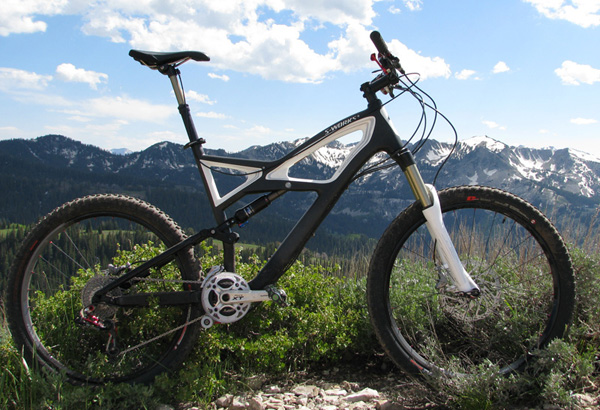
Of course, most of the ride was pointing downhill. Flip the ProPedal to fully active. Set the fork to its full 160mm of travel. Use the Command Post Seatpost to lower the saddle while in motion (more on this product in a separate review to appear soon) and sit back and enjoy the ride. The secret to the Enduro is the new X-wing design carbon frame. It makes for a much lighter and stiffer frame than the 2009 version of the same machine, and provides a very solid connection point for the rear shock. The design also provides more standover height. It's truly remarkable what can be done with carbon. Here we have a bike that is capable of doing jumps, blasting rock gardens and more, and yet it is a carbon frame and a carbon crown/steerer fork. I'm impressed. It had no bad habits as far as I'm concerned. I'd be happy to own this bike.
Other tweaks on the S-Works Enduro for going downhill are 203mm rotors with the Avid XX brakes, a custom Shimano XT crank with 22/36 rings (with a bash guard and Gamut chain guide) and 2.3” Specialized Eskar tires. The entire package performed just superbly on this monster downhill ride. You weren't doing a great deal of pedalling, but you certainly were on the brakes a lot. The Avid XX brakes were a bit more on and off than I'm used to. My own all-mountain bike has Shimano Saint brakes and I would have preferred them, thanks to their superior modulation. However, the decision was made to go with the XX brakes because they are considerably lighter than Saint.
On this carbon frame there is one other trick bit. It comes with ISCG tabs that are actually a separate piece that is held in place by the bearing cup. It's a very slick bit of engineering. One of the immediate questions was with regards to installing Hammerschmidt (internal front shifting). The response from the Specialized crew was that they had definitely tried it, but it was too heavy for their liking. We'll see what happens in that context.
The other comment was “Great bike. Who can afford it?” That came about even though we weren't given a price on the S-Works. The response was that you can get the benefits of this design but not drop a bundle. There are 2 carbon models, the S-Works tested and a Pro Carbon, and 3 alloy framed models (Pro, Expert and Comp). The alloy-framed models are going to be about 30 pounds. The specifications of these models haven't been finalized. Based on what I saw expect a mixture of components leaning mostly to SRAM.
Wish list? I'd like to lose a couple more pounds. I'd go with a regular seat post. Get rid of the chainguide. As wide and as light a tire as I could find. Lightweight tubes or tubeless too. In retrospect, though, these are minor changes. The S-Works Enduro is a very complete bike as it is. It was a heck of a lot of fun and I have to congratulate Specialized on a job well done.
There were some really exciting things coming from Specialized to the riding public for 2010. I honestly didn't think that carbon could be pushed this far, but clearly it has come a long way in a short time. The ability to tune it for so many applications is remarkable. Specialized has definitely taken advantage of its abilities, and their own abilities to design unique products.
Thanks to Specialized and Specialized Canada for getting us to the Product Launch. Always a pleasure to hang out with other bike geeks!
| Return to Canadian Cyclist homepage | Back to Top |